Part 3: What We Won, What We Lost
An honest retrospective on building a type-safe MongoDB ODM — the wins, the scars, and the edge cases that keep us humble.
Every abstraction is a bet. You trade some flexibility for safety, some simplicity for power. Vellum is no different. After shipping v0.1, here's what the ledger looks like.
What We Won
1. Zero-String Queries
This is the headline feature, and it genuinely delivers:
# Before (raw pymongo)
products = await collection.find({
    "category": "electronics",
    "price": {"$gte": 10, "$lte": 500},
    "tags": {"$in": ["sale", "clearance"]},
    "deleted_at": None,
}).sort([("price", -1)]).to_list(None)

# After (Vellum)
products = await repo.find(
    (Product.category == "electronics")
    & (Product.price >= 10)
    & (Product.price <= 500)
    & (Product.tags.in_(["sale", "clearance"]))
    & ~Product.is_deleted(),
    sort=[Product.price.desc()],
)
The second version is:
- Shorter — 7 lines → 10 lines (but each line is simpler)
- Discoverable — Ctrl+Space shows available fields
- Refactorable — rename category to product_category? All queries update automatically
- Composable — conditions are Python objects, you can store, combine, reuse them
2. Composable Expression Trees
Query expressions are first-class values. You can build them incrementally:
# Build a dynamic filter without string concatenation
def build_product_filter(filters: ProductFilters) -> QueryExpression | None:
    conditions = []
    if filters.min_price is not None:
        conditions.append(Product.price >= filters.min_price)
    if filters.max_price is not None:
        conditions.append(Product.price <= filters.max_price)
    if filters.categories:
        conditions.append(Product.category.in_(filters.categories))
    if filters.only_available:
        conditions.append(Product.stock > 0)
    if not conditions:
        return None
    return functools.reduce(operator.and_, conditions)
This is type-safe, testable, and composable. No string interpolation, no if ladders building dicts, no risk of $and vs $or confusion.
3. Consistent API Across Operations
The same FieldRef syntax works everywhere — queries, sorts, indexes, aggregations, updates:
# Query
repo.find(Product.price < 10)

# Sort
repo.find(sort=[Product.price.desc()])

# Index
Index(cls.price.desc(), cls.name.asc())

# Aggregation
pipeline.group(Order.product_id, total={"$sum": Order.total})

# Update
UpdateBuilder(repo.collection, doc_id).inc(Product.stock, -1).push(Product.tags, "sold")
One concept, six use cases. The learning curve is shallow — once you understand FieldRef, you know the whole API.
4. Gradual Adoption
Raw dicts still work everywhere. You can migrate model by model, or even query by query:
# Fully typed
products = await repo.find(Product.price < 10)

# Mixed — no problem
products = await repo.find(
    {"price": {"$lt": 10}},
    sort=[Product.price.desc()],
)

# Fully raw
products = await repo.find(
    {"price": {"$lt": 10}},
    sort=[("price", -1)],
)
This is critical for existing projects. You don't need a rewrite — just start using typed expressions for new queries.
5. Aggregation Without $ Strings
Aggregation pipelines are notorious for $field string references. Vellum auto-converts FieldRef objects:
pipeline = AggregationPipeline(collection)
results = await (
    pipeline
    .match(Order.total > 100)
    .group(Order.product_id, total_revenue={"$sum": Order.total})
    .sort(SortSpec("total_revenue", -1))
    .execute()
)
Order.total inside {"$sum": Order.total} is automatically resolved to "$total" by resolve_agg_refs. No $ prefix, no string literals.
What We Lost
1. Metaclass Complexity
The custom metaclass (VellumMetaclass) is the single most fragile part of the codebase. It couples us to pydantic v2's internal attribute storage (__pydantic_fields__). If pydantic v3 changes how fields are stored, our metaclass breaks silently.
class VellumMetaclass(ModelMetaclass):
    def __getattr__(cls, name: str):
        if name.startswith("_"):
            raise AttributeError(name)  # pydantic internals probe these
        fields = cls.__dict__.get("__pydantic_fields__", {})
        if name in fields:
            return FieldRef(name)
        raise AttributeError(...)
The _ guard is a band-aid. We're catching all _-prefixed names and raising AttributeError — which is correct, but it means any future pydantic version that stores metadata under a new _ attribute could cause subtle issues.
2. No FieldRef.$ Property
You can't write Order.$total — $ is not a valid Python identifier. This means the aggregation auto-conversion via resolve_agg_refs() is necessary, adding an extra layer of indirection that's not obvious to new users.
# What we WISH worked:
Order.$total  # SyntaxError: invalid syntax

# What we have:
{"$sum": Order.total}  # resolve_agg_refs converts Order.total → "$total"
It works, but it's magic. Users need to understand that FieldRef inside a dict gets special treatment.
3. __init_indexes__ Surprise
The dual API for indexes (Settings.indexes vs __init_indexes__) is necessary but ugly:
class Product(VellumBaseModel):
    class Settings:
        indexes = [
            Index("name"),  # string — works in class body
        ]

    @classmethod
    def __init_indexes__(cls):
        return [
            Index(cls.price.desc()),  # FieldRef — works after class creation
        ]
New users consistently ask "why two ways to define indexes?" The answer (class body scoping rules) is a language detail that shouldn't leak into the API, but does.
4. HooksMixin Limitations
The HooksMixin lifecycle hooks (before_insert, after_insert) work, but they're called explicitly in the repository — not automatically. If someone calls collection.insert_one(doc) directly, the hooks don't fire. This is a leaky abstraction:
class Order(VellumBaseModel):
    async def before_insert(self):
        self.total = self.quantity * self.unit_price  # won't fire if bypassing repo

# Repository — hooks fire
await repo.create(order)

# Direct Motor — hooks DON'T fire
await db.orders.insert_one(order.to_mongo())
We chose explicit over magical (hooks in __setattr__ would be too invasive), but it means the abstraction boundary is the repository, not the model.
Edge Cases We Discovered
UUID Coercion
MongoDB stores UUIDs as strings. When querying by _id, users pass a UUID object, but MongoDB expects a string:
# User writes:
repo.get(UUID("..."))  # passes UUID object

# FieldRef.__eq__ handles it:
class FieldQueryExpression:
    def _to_mongo_value(self, value):
        if isinstance(value, UUID):
            return str(value)
        return value
We handle this in FieldQueryExpression._to_mongo_value(), but it's easy to forget. Any new query operator must remember to apply this conversion.
Optimistic Concurrency
The OptimisticConcurrencyMixin increments version on every write, but the check happens in repository.update() — not in UpdateBuilder:
class VellumRepository:
    async def update(self, doc_id, item, session=None):
        if isinstance(item, OptimisticConcurrencyMixin):
            result = await self.collection.update_one(
                {"_id": doc_id, "version": item.version},
                {"$set": doc, "$inc": {"version": 1}},
                session=session,
            )
            if result.matched_count == 0:
                raise OptimisticLockError(...)
If someone uses UpdateBuilder directly, they bypass optimistic locking. The abstraction gap between repository-level operations and builder-level operations is a real source of bugs.
The Tradeoff Quadrant
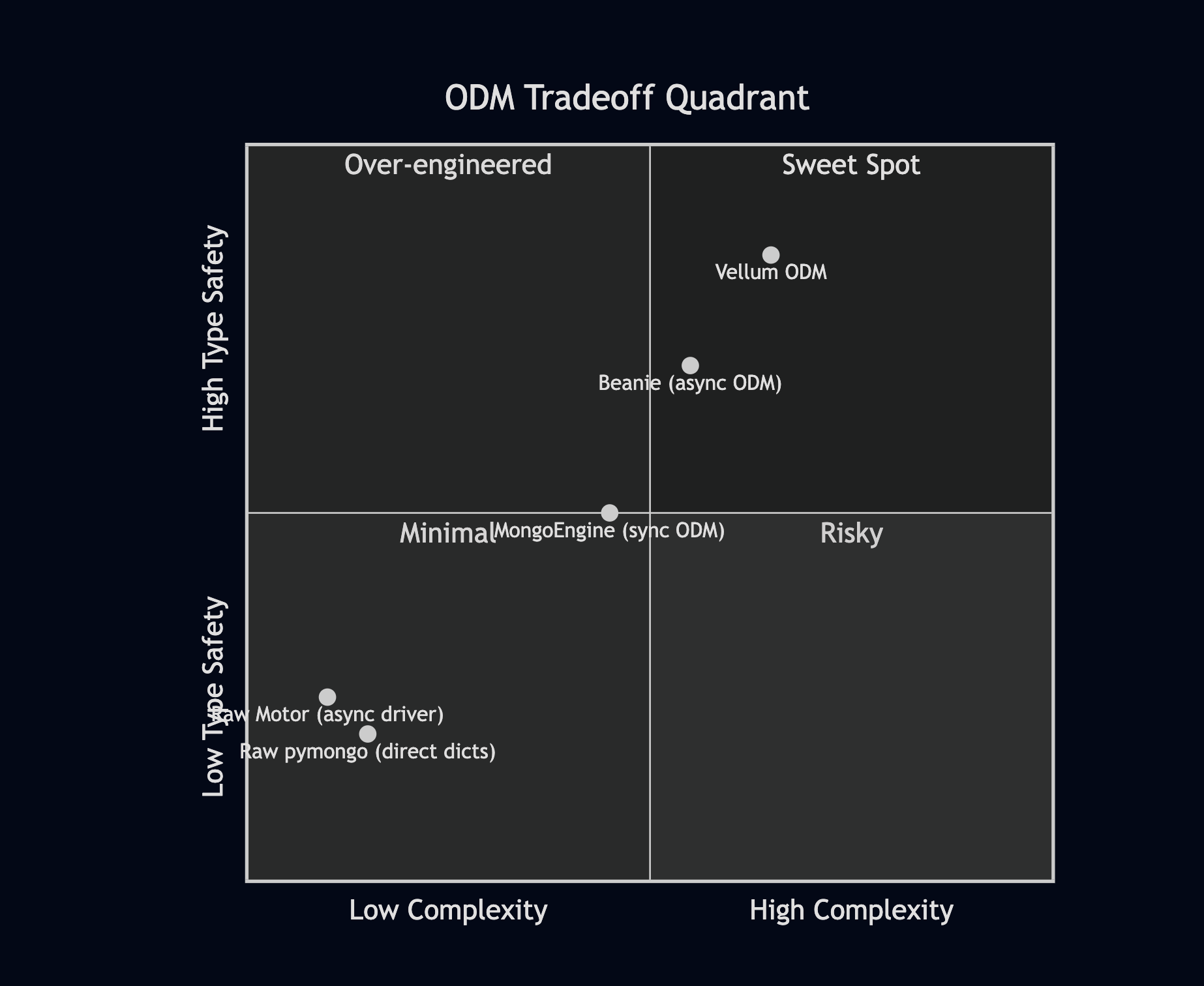
- Raw pymongo/Motor: Low complexity, low safety — you're writing JSON queries by hand
- MongoEngine/Beanie: Medium complexity, medium safety — some ORM patterns but still string-heavy
- Vellum: Higher complexity (metaclass, builder patterns), highest safety — zero-string queries, IDE support, composable expressions
When to Use Vellum
Use it when: - Your project has 10+ models with 50+ fields each - Multiple developers work on the same codebase - You refactor schemas frequently - You want IDE autocomplete for MongoDB queries - You're building a new project (easier than retrofitting)
Think twice when: - You have 1–3 simple models - You're migrating an existing codebase with thousands of raw queries - You need to support pydantic v1 (we're tied to v2 internals) - You need sync-only MongoDB (no async support)
The Verdict
gantt
    title Vellum Development — Effort by Category
    dateFormat  YYYY-MM-DD
    axisFormat  %b %d
    section Core Engine
    FieldRef + operator overloading  :a1, 2d
    Metaclass design                  :a2, 3d
    Query expression tree             :a3, 3d
    Aggregation ref resolver          :a4, 1d
    section Integration
    Pydantic v2 compatibility         :b1, 4d
    Repository layer                  :b2, 2d
    UpdateBuilder                     :b3, 1d
    section Polish
    Index design + validation         :c1, 3d
    Build system switch               :c2, 1d
    Docs + examples                   :c3, 3d
    "Bug fixes (push, restore, sort)"   :c4, 1d
The core engine (FieldRef, metaclass, expressions) took ~40% of total development time. Integration with pydantic and Motor took another ~35%. Polish and docs took the remaining ~25%.
The metaclass work was the hardest — and the most rewarding. Once it works, the rest of the API flows naturally from it.
Final Thoughts
Building Vellum taught us that type safety in a document database is a spectrum, not a binary. You can't make MongoDB statically typed — it's schemaless by design. But you can make the interface to MongoDB statically typed, catching field name typos and operator errors before they hit the database.
The cost is complexity in the abstraction layer. Every line of metaclass code, every _to_mongo_value conversion, every resolve_agg_refs recursive walk is a potential failure point.
But for the developer writing a query at 2 AM, the API speaks for itself:
Product.price < 10
No strings. No $ prefixes. No surprises. Just Python.
And that's worth the cost.